

The Federal Government has announced the commencement of operations at a high-purity gold refinery in Lagos and disclosed that a $600 million lithium processing plant in Nasarawa State is ready for commissioning, marking a major step in Nigeria’s drive to deepen local value addition in the mining sector.
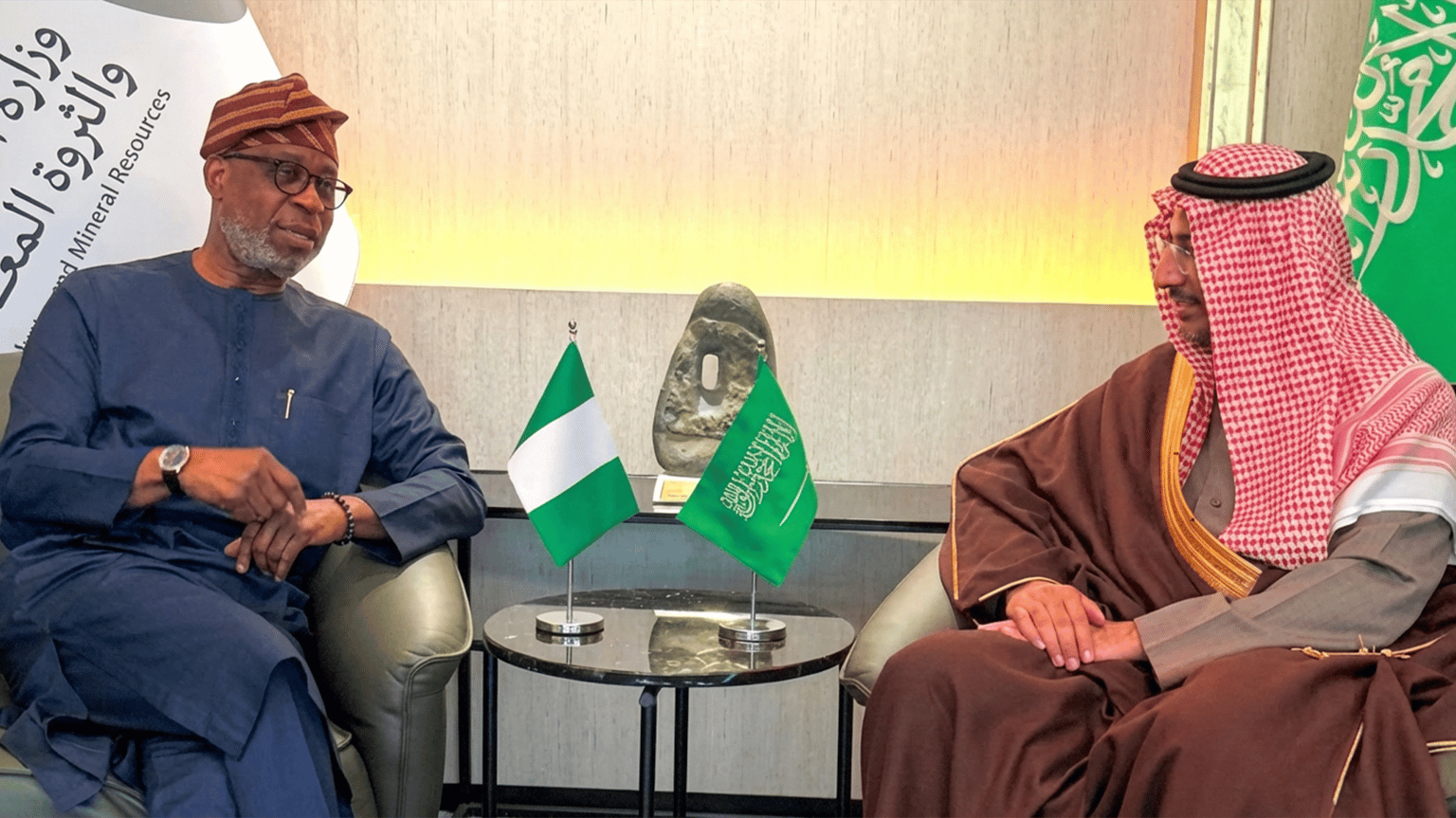
The Minister of Solid Minerals Development, Dr. Dele Alake, made this known on Tuesday during a bilateral meeting with Saudi Arabia’s Minister of Industry and Mineral Resources, Ibrahim Al-Khorayef, held ahead of the Future Minerals Forum in Riyadh.
Alake said the developments underscore the success of the Federal Government’s value-addition policy, which aims to curb the export of raw minerals and position Nigeria as a competitive player in global supply chains for critical minerals.
“Nigeria’s value-addition policy is already yielding tangible results, with a gold refining plant of very high purity now operational in Lagos, three additional gold refineries at various stages of development, and a $600 million lithium processing plant in Nasarawa State ready for commissioning,” the minister said.
According to a statement issued by his Special Assistant on Media, Segun Tomori, the meeting focused on strengthening bilateral cooperation between Nigeria and Saudi Arabia in the solid minerals sector and translating previous engagements into measurable outcomes.
Alake explained that the operational Lagos refinery and the upcoming lithium plant reflect the government’s determination to promote in-country beneficiation rather than exporting unprocessed mineral resources. He added that lithium, gold and other critical minerals are central to Nigeria’s economic diversification agenda and its participation in global energy transition value chains.
The minister expressed Nigeria’s readiness to expand collaboration with Saudi Arabia, particularly in areas where both countries possess complementary strengths.
“There are areas of comparative advantage where Saudi Arabia excels and others where Nigeria has strengths. We are keen on structuring agreements that will enable us to engage meaningfully and constructively,” he said.
He identified priority areas for cooperation to include capacity building, training of mining professionals, technology transfer and mineral exploration, noting that Saudi Arabia has demonstrated strong expertise in these fields.
Alake also highlighted Nigeria’s vast landmass and significant deposits of critical minerals and rare earth elements, describing the Future Minerals Forum as a strategic platform to refine partnerships based on fairness, equity and mutual benefit.
He recalled that a joint working group involving officials from Nigeria and the Saudi Chamber of Commerce, established after the 2025 edition of the forum, has remained active and is expected to submit its report before the end of the current meeting.
According to him, key focus areas identified for collaboration include mineral traceability, Environmental, Social and Governance (ESG) standards, and mine-pit remediation. He noted that effective traceability systems enhance investor confidence and should be supported with clear timelines, as well as robust monitoring and evaluation frameworks.
In his remarks, Saudi Arabia’s Minister of Industry and Mineral Resources, Ibrahim Al-Khorayef, described Nigeria as a long-standing ally and agreed on the need to move beyond discussions to practical and actionable agreements in solid minerals development.
He proposed that the joint working group prepare a draft memorandum of understanding for possible signing on the sidelines of the forum. Al-Khorayef also encouraged Nigeria to use the platform to showcase its mining investment opportunities, while urging African countries to adopt advanced mining technologies, noting that Nigeria could benefit from Saudi Arabia’s experience in the sector.
Nigeria has in recent years intensified reforms in the mining industry, including efforts to curb illegal mining, strengthen regulation and attract investment through incentives and a renewed emphasis on local processing.
The Federal Government views the expansion of refining and processing capacity as critical to capturing greater value from the country’s vast mineral resources and driving sustainable economic growth.








Leave a Reply