

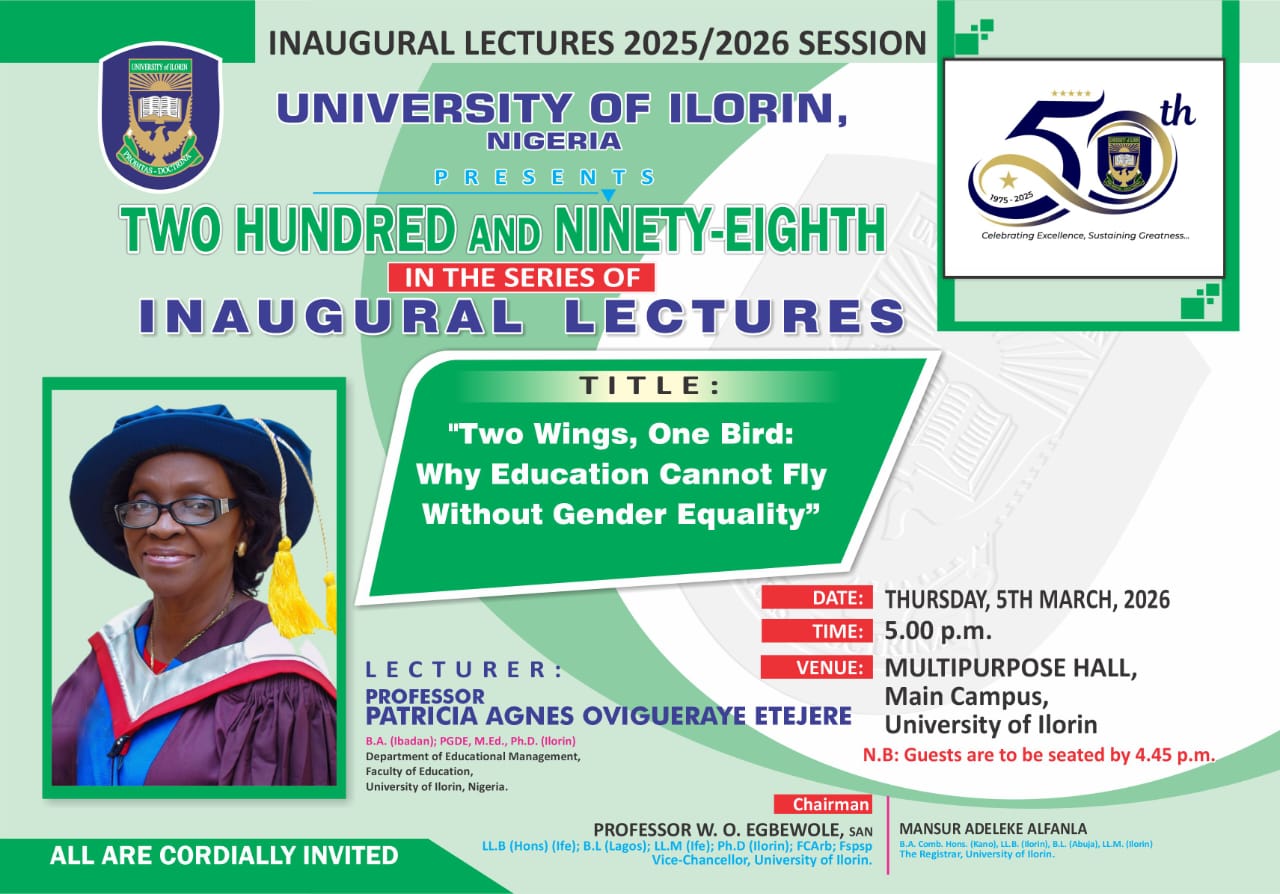
A Professor of Educational Management at the , Patricia Agnes Ovigueraye Etejere, has emphasised that education cannot achieve its full potential without gender equality.
Etejere made the assertion while delivering the institution’s 298th inaugural lecture titled “Two Wings, One Bird: Why Education Cannot Fly Without Gender Equality.”
Speaking at the lecture held in Ilorin on Thursday, the don explained that both men and women must be given equal opportunities for the education system to function effectively.
According to her, when gender balance exists in educational institutions, productivity, innovation and institutional growth improve significantly.
“When both wings are strengthened and men and women experience fairness, opportunity and recognition, institutions gain psychological safety, mutual respect and shared accountability,” she said.
Etejere noted that her academic work spanning more than two decades had focused on advancing knowledge in educational management, particularly in gender studies, higher education governance, quality assurance and information and communication technology in education.
She explained that earlier studies on female postgraduate students in Nigerian universities revealed that factors such as limited spousal support, time constraints, financial challenges and fear of delayed completion often contributed to higher dropout rates among women.
The professor also highlighted how socio-cultural norms, institutional practices and economic structures continue to sustain gender inequalities in education.
Citing previous research, she said women face significant challenges in the digital and global economy due to limited access to ICT education and persistent stereotypes that discourage them from pursuing careers in science and technology.
Etejere therefore stressed the need for deliberate policies and programmes that encourage women’s participation in education and leadership.
She recommended the establishment of gender-responsive educational systems that promote inclusive learning environments where access, participation and leadership opportunities are equitably distributed.
The scholar also called for the formulation and implementation of gender-responsive policies backed by adequate funding and reliable data to guide educational planning.
Other recommendations included integrating gender mainstreaming across all levels of education, prioritising scholarships and leadership development programmes for female students, and creating supportive institutional cultures that promote diversity and fairness.
Etejere further urged educational leaders to invest in ICT infrastructure and digital capacity building to ensure equal access to technological opportunities for both men and women.
She concluded that families, communities and policymakers must collectively support gender equality in education to achieve sustainable national development.
“A gender-responsive education system requires collective responsibility from policymakers, institutions, families and communities to nurture equitable values and strengthen the balance required for sustainable national development,” she said.






Leave a Reply